An internal operational tracking form for drone operators to log, manage, and audit LAANC airspace authorizations by individual mission.
Last updated
The LAANC Airspace Authorization Tracker is an internal operational form that drone operators use to log, manage, and audit FAA LAANC airspace authorizations on a per-mission basis. It records mission identification, site coordinates, authorization IDs from providers such as Aloft or SkyVector, approved altitude ceilings, aircraft registration details, flight window parameters, compliance attestations, and any post-flight deviations — creating a complete, audit-ready record that satisfies the two-year retention requirement under 14 C.F.R. § 107.49.
The LAANC Airspace Authorization Tracker should be completed for every drone flight conducted under a LAANC authorization in Class B, C, D, or surface-level Class E airspace. It is especially critical when shooting real estate photography, Matterport 3D tours, or reality-capture scans near controlled airports, when multiple crew members share a drone fleet, or when a client, insurer, or FAA inspector may later request proof that a valid authorization existed before takeoff.
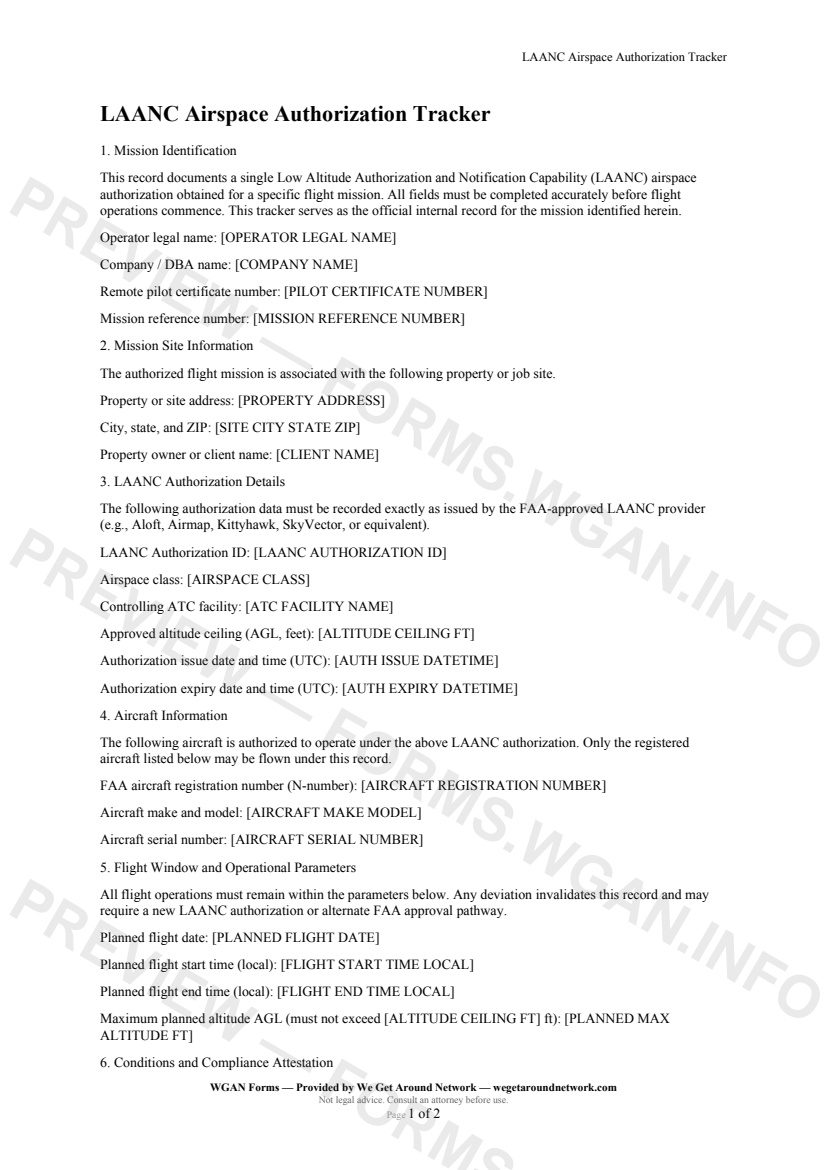
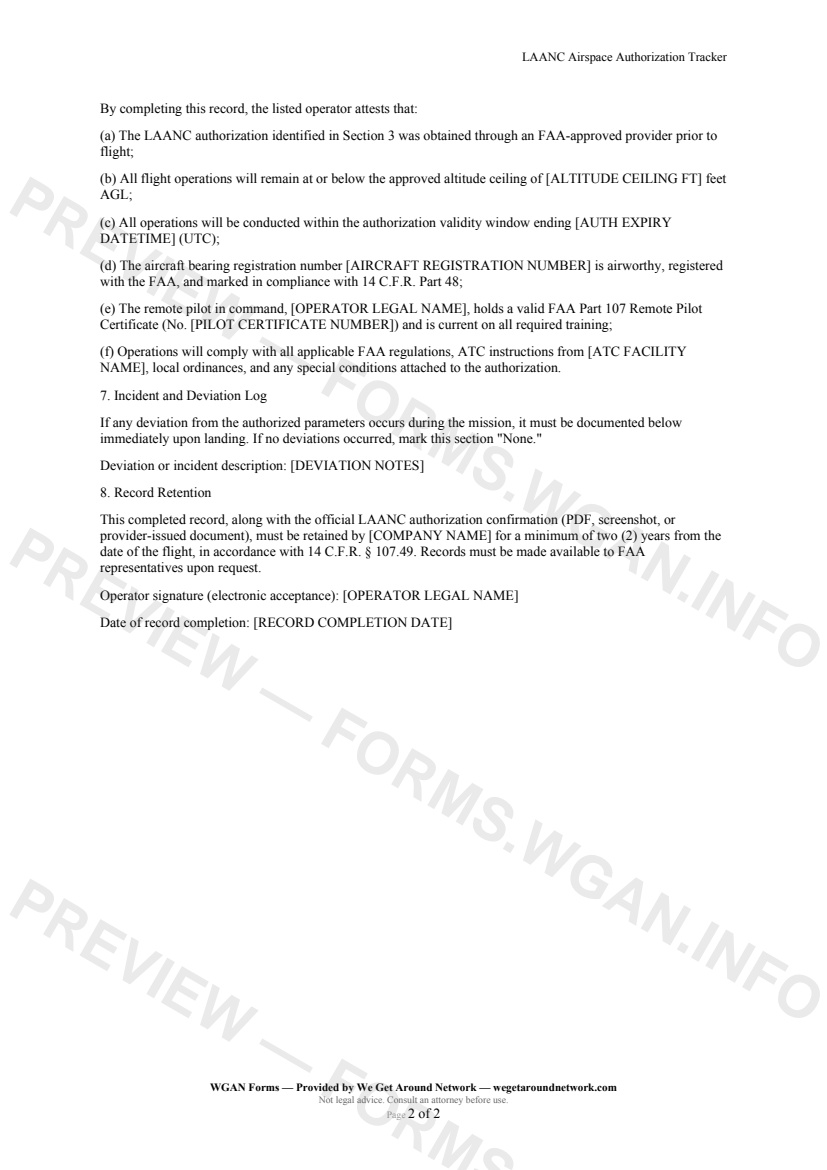
First 2 pages shown — watermarked. Subscribe to fill out and download the unbranded document.
Every flight record begins with your internal mission reference number, operator legal name, FAA Part 107 certificate number, and company or DBA name — giving you a clean audit trail that ties each authorization to a specific operator and job.
This is the heart of the tracker. You'll capture:
Log the FAA N-number, aircraft make and model, and serial number for the specific drone authorized under this record. Only the registered aircraft listed may fly under this authorization.
Record your planned local start and end times alongside your planned maximum altitude. The form cross-references your planned altitude against the approved ceiling, reminding you that no deviation is permitted without a new authorization.
A structured checklist confirms that the authorization was obtained before flight, the aircraft is airworthy and properly marked under 14 C.F.R. Part 48, and the remote PIC is current on all required training — making this record ready for an FAA ramp check.
A dedicated post-flight section captures any deviations from authorized parameters. If none occurred, a simple "None" entry closes out the record cleanly.
All completed records must be retained for a minimum of **two years** per 14 C.F.R. § 107.49.
Other templates capture pros use alongside this one.
Aerial Services Scope Addendum — WGAN 2026 form template.
Post-Flight Checklist & Flight Log — WGAN 2026 form template.
A drone-operator disclosure form identifying no-fly zones, TFRs, and restricted airspace that affect a shoot, with proposed alternatives for real estate and proptech clients.
FAA Part 107 Pre-Flight Checklist — WGAN 2026 form template.